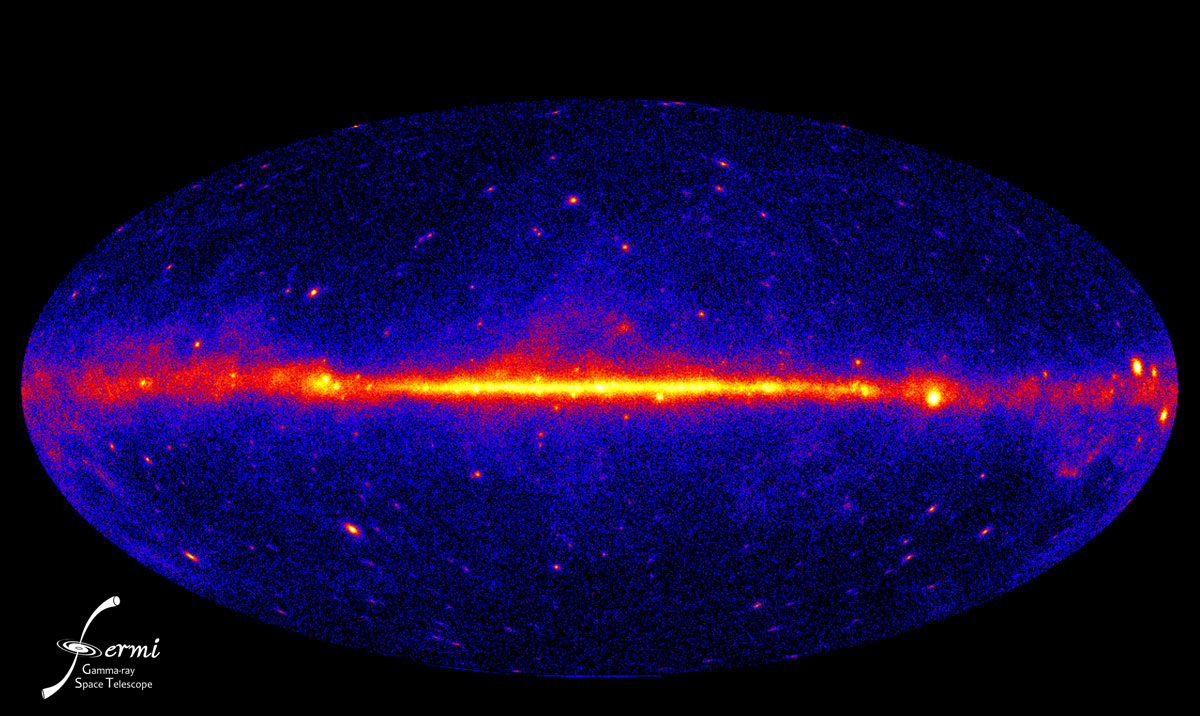
 The gamma-ray sky as measured by the FGST during its first year (Credit: NASA/DOE/Fermi LAT Collaboration)
The Fermi Gamma-Ray Space Telescope (FGST), launched into orbit in June of 2008, represents an exciting endeavor in high-energy astrophysics due to the unprecedented sensitivity and precision with which it is measuring the gamma-ray sky. Able to detect photons of energies up to 300 GeV (a full order of magnitude higher than its predecessor), the telescope's angular resolution exceeds that of previous gamma-ray telescopes by a factor of 2 and surpasses their field of view by a factor of 4, enabling the telescope to survey the entire sky every 2 orbits. Due to these exceptional advances, Fermi's first year of data is already more precise and comprehensive than any previous survey.
One compelling aspect of this new data is that it imposes new constraints on the parameters that govern gamma-ray producing processes within our galaxy. These processes include Bremsstrahlung, Inverse-Compton Scattering, and neutral pion decay, which depend on the galaxy-wide spectrum and distribution of cosmic-rays as well as the interstellar gas and radiation fields. Because of the resolution with which Fermi can measure the spatial and spectral features of the gamma-ray sky, the contribution from each of these processes can be isolated and studied individually, yielding detailed information about the production and propagation of cosmic-rays in the Milky Way.
This analysis is carried out by modeling our galaxy with differing physical parameters and comparing the simulated predictions to Fermi's observations. The effects of individual model parameters can be determined by varying each seperately; however, current simulations involve over 40 parameters, most of which are only weakly constrained by the local cosmic-ray spectrum. Moreover, many of these parameters depend on each in nonlinear and not well understood ways, necessitating the use of high-dimensional parameter spaces in optimization. Despite this difficulty, significant improvements have been made to galactic models through an in-depth study of eleven parameters including those relating to interstellar gas density, the distribution of cosmic-ray sources throughout the galaxy, and the diffusion equation governing cosmic-ray propagation within our galaxy.
Such an optimized model provides the best estimate of the parameters governing the Milky Way, which is especially useful in the case of parameters that cannot be measured directly such as the diffusion coefficient governing cosmic-ray propagation. Yet optimization has further applications; for instance, the study of extragalactic gamma-rays is limited by the precision with which the galactic component can be modeled and subtracted from the overall gamma-ray sky. Galactic models also serve as a gamma-ray background from which astrophysical gamma-ray sources can be identified. This is important because the angular resolution of the FGST is not precise enough to confidently exclude gamma-ray point sources, making background measurements unreliable. The anisotropy of the gamma-ray sky also complicates this problem, since a measurement at high galactic latitudes cannot be used to study sources near the galactic center. Thus, our ability to detect sources such as supernova remnants, spinning neutron stars, and supermassive black holes in the center of distant galaxies depends on the sophistication with which we can simulate the diffuse gamma-ray sky.
The FGST has already improved our knowledge of high-energy processes within the galaxy and it will continue to do so as more data accumulates and is studied. These advances will surely benefit other facets of astrophysics as our models become more sophisticated and incorporate an increasing amount of specialized knowledge. In the meantime, it's never to early to start designing the next-generation gamma-ray telescope.
Gehrels, N. and P. Michelson, Astropart. Phys. 11, 277 (1999).


No comments:
Post a Comment